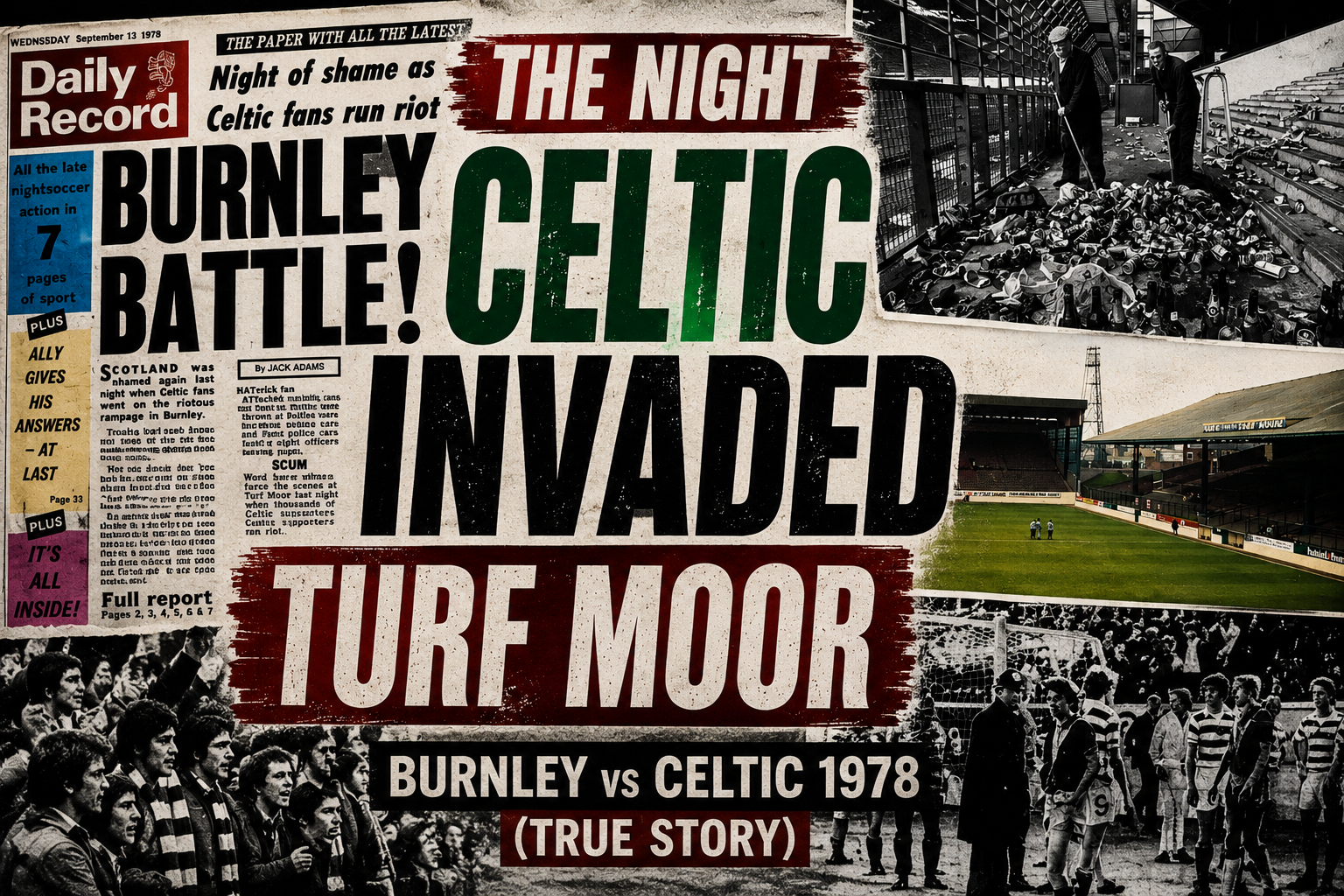
An event still talked about nearly 50 years later. Celtic’s visit to Burnley’s Turf Moor stadium was one of the most brutal episodes of football hooliganism, ever seen in a British football stadium. The Anglo Scottish Cup was a contest between Scottish and English clubs invented in the early 1970s, but it was fraught with danger, especially when Scotland’s big clubs had to play in England. And hence this night in September 1978 has gone down in hooligan folklore. Let’s get on with the stories.
The Burnley Perspective
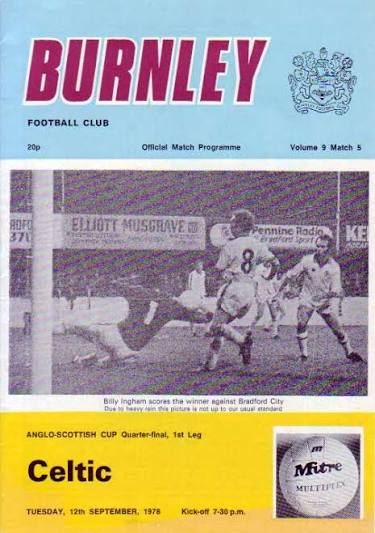
First we have ex- Burnley Suicide Squad member, Brendan, who told us….“Ah, Burnley vs Celtic 1978. I thought I’d seen everything football could throw at you by September 1978. I’d followed Burnley all over the country through good times and bad, seen the odd scrap outside grounds and plenty of heated afternoons on the terraces, but nothing had ever stopped me looking forward to a match. The Anglo-Scottish Cup wasn’t exactly glamorous, yet the thought of Celtic coming to Turf Moor gave the town a buzz. We’d heard thousands were travelling south and expected a lively atmosphere. Walking into Burnley that afternoon, I could already tell this wasn’t going to be an ordinary fixture. Coaches were arriving one after another, pubs were overflowing and green-and-white scarves seemed to be everywhere. Some of the visitors were perfectly friendly, exchanging jokes and talking football, while others had clearly been drinking since breakfast. Every pub doorway seemed packed with singing supporters. Even the police looked uneasy, watching the crowds build hour by hour.”
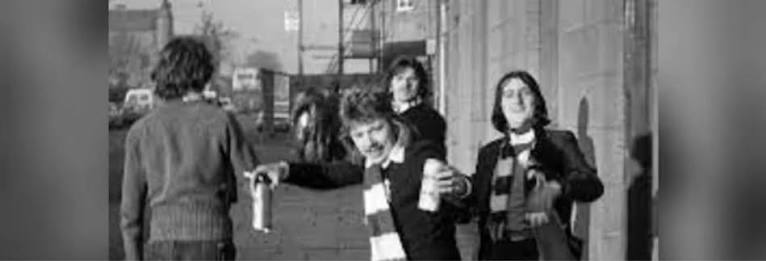
“By the time I reached Turf Moor, the place felt unlike anything I’d experienced before. The Longside was filling quickly, while the Cricket Field corner behind the railings had become a sea of green and white. The noise was incredible, bouncing off every stand as songs from both sets of supporters echoed across the ground. We answered their singing with our own, and they answered back even louder. Nobody around me seemed interested in the Anglo-Scottish Cup itself anymore. It felt as though the occasion had become bigger than the football. Looking around, I noticed Celtic supporters appearing in sections where you’d never normally expect away fans to be. People whispered that hundreds had jumped the turnstiles because there simply weren’t enough police to stop them. My mate nudged me and laughed that Turf Moor had become Celtic Park for the evening. I laughed too, but deep down I wasn’t quite as relaxed as I pretended to be.”
How The Trouble Started
“When Steve Kindon put Burnley in front, I celebrated like everyone else around me. We’d been written off by plenty before kick-off, so seeing the ball hit the net felt brilliant. Yet the celebrations lasted only moments before attention shifted away from the pitch. People were looking towards the dividing fence rather than the players. The atmosphere changed almost instantly. Stewards, police and supporters all seemed unsure what would happen next. Celtic fans first tried to rip the dividing fence down. Then used the railings as spears, like a scene out of Zulu. How someone wasn’t killed that day I’ll never know. Supporters began edging away while others climbed onto the perimeter wall simply to see what was happening further along the terrace. The referee eventually halted play as more officers appeared. Standing there, I realised nobody was watching the football anymore. Thousands of people had fallen silent, waiting to see how things would unfold. I’d never known a football match where the result suddenly seemed the least important thing happening inside the ground.”
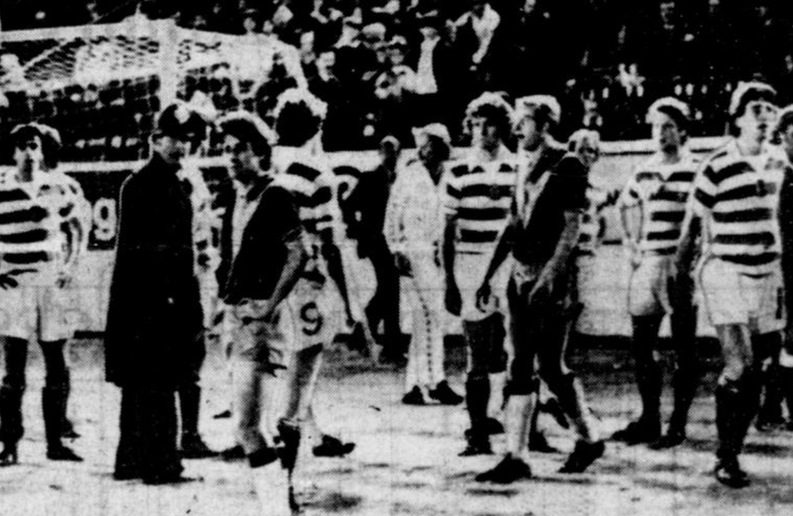
“Then it got really nasty. They started to climb into our stand some with blood soaked bandaged heads looking for all the world like Pirates boarding a ship. The longside had a fence to separate the fans in those days and after throwing hundreds of empties over it they then proceed to break the fencing up they threw concrete and fence posts at the Burnley fans I saw a man close behind me get struck with a lump of concrete and fall to the floor with blood gushing from his head, neither police nor the club had any clue how to handle it. The game continued as hundreds of Burnley fans tried to escape the area the game was suspended eventually, to allow them to escape and watch the game from elsewhere in the ground. It was a miracle nobody was killed or severely injured, I was scared to death absolutely the worst night of violence, I have ever experienced. Bottles, steel railings bricks and any other detritus, the Celtic fans could find were coming our way. I honestly thought we were goners. I was at the midpoint of the home end of the longside, halfway along halfway down it was horrible it wasn’t just the main group of Celtic, coming at us from the right, they’d also found their way across at the back of the longside where the steps led down to the toilets, and so we got rushed from the right and from behind. That was it, the Longside had fallen. All hoipe was lost and we were shepherded off and out of the ground by police horses and not let back in.
Trouble Outside Turf Moor
“After we left, the game resumed and Burnley held on to win 1–0, but hardly anyone spoke about the football as we left Turf Moor. Instead, everyone compared stories about where they’d been standing and what they’d seen. Walking back towards the town centre, police vehicles, ambulances and mounted officers were everywhere. The streets remained crowded long after the final whistle, and conversations carried on late into the night. The following morning, newspapers were full of photographs that hardly seemed believable for a match in a competition many people barely cared about. Friends who’d stood in different parts of the ground all had completely different recollections, yet every one of them agreed it was a night unlike anything they’d witnessed before. Even older supporters, men who’d watched Burnley since before the war, admitted they had never experienced an atmosphere quite like it.”
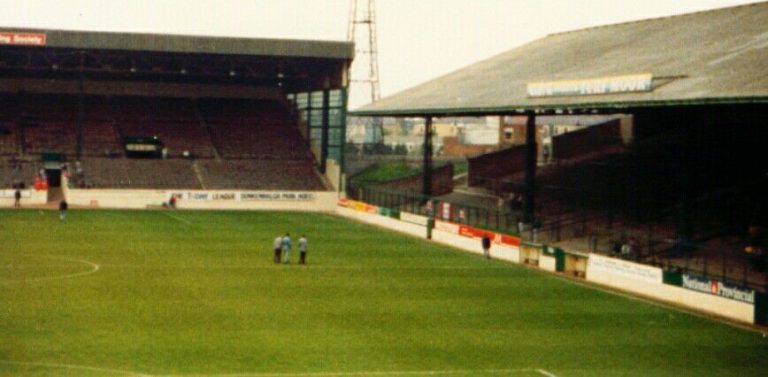
“Years later, people still ask me about that evening whenever Burnley and Celtic are mentioned together. They expect tales about the match itself, but I always remember the feeling rather than the score. I remember the endless coaches arriving, the songs drifting across Burnley from lunchtime onwards and the sense that something unusual was unfolding before a ball had even been kicked. Burnley would go on to win at Celtic Park and eventually lift the Anglo-Scottish Cup, but the trophy became almost an afterthought. Whenever old supporters meet, the conversation always returns to that September night when Turf Moor became the centre of the football world for reasons nobody had expected. It remains one of those evenings that everyone remembers differently, yet somehow remembers exactly the same.”
Celtic Hit Back
Celtic Green Brigade member Peter told us….”Missing out on Europe hurt every Celtic supporter I knew. We’d spent years dreaming about trips to Munich, Madrid and Milan, only to find ourselves heading for Burnley in the Anglo-Scottish Cup. Most of us laughed it off. It was still Celtic away, and thousands were determined to make the journey. Our bus left Glasgow before dawn, packed with scarves, sandwiches and enough songs to last the entire trip south. Every service station seemed to fill with more Celtic supporters until it felt like we were travelling as one enormous convoy. By the time we reached Lancashire, Burnley looked completely transformed. Green and white shirts filled the streets, pubs echoed with familiar songs and strangers greeted one another like old friends. English football always felt different, and there was a certain pride in travelling in such numbers. Wherever Celtic went, we believed we’d make ourselves heard, and that afternoon was no exception.”
“The closer we got to Turf Moor, the more obvious it became that the town wasn’t prepared for us. Queues stretched outside every pub, supporters spilled onto the pavements and police officers seemed to be appearing from every direction. Most of the people I met that afternoon simply wanted a drink and a laugh before kick-off, though plenty had clearly started celebrating long before arriving in Burnley. As we made our way into the ground, I could hear chants coming from the Burnley end referencing Rangers and other songs we considered provocative. Whether they meant anything by them or not, plenty around me took them personally. Before long, our section answered back with songs of our own. The football almost felt secondary. It became a battle of voices across the terraces, each side trying to drown out the other. Looking around at the sea of green and white, I couldn’t help feeling proud of how many of us had travelled for a competition most people dismissed.”
Celtic Fans Riot
“When the match settled down, I tried to focus on the football, but the atmosphere never truly relaxed. Everywhere I looked, supporters were craning their necks towards the dividing fences instead of watching the ball. Rumours spread quickly through the crowd that away fans had entered other parts of the ground and that the police were struggling to cope with the numbers. Whether the stories were true hardly mattered; they added to the tension that had been building since lunchtime. Then Steve Kindon scored for Burnley, and the mood shifted completely. The roar from the home supporters was deafening, while around me frustration boiled over. Almost instantly, attention moved away from the pitch as people began pointing towards the Longside. Celtic fans began attacking the home section with bottles, railings, bricks, concrete, just anything really. The Burnley fans held for a while but then went into a full on retreat, literally running for their lives. Their end, the Longside had been taken by a mob of about 2,000 Celtic. The referee stopped play, players disappeared from view and nobody seemed quite sure what was happening beyond the rows of supporters standing in front of us. It felt less like a football match and more like a city trying to contain an event that had become far bigger than anyone expected. The Burnley fans were now all on the pitch by the corner flag and were being shepherded out of the ground for their own safety, with the Celtic fans still throwing everything they had at the retreating police. It was now a full scale riot and we basically scattered Police and Burnley fans to the wind. Once they had all retreated far enough away, the fans settled down in the Burnley home end, singing songs about the I.R.A and all that stuff.”
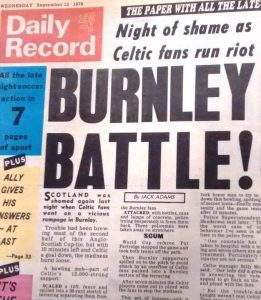
The Journey Home
“Eventually, the players returned and the match finished with Burnley winning 1–0. As we filtered out of Turf Moor, conversations were completely different from those we’d been having before kick-off. Nobody spoke about tactics or missed chances. Instead, everyone tried to piece together their own version of what had happened. Some blamed the policing, others blamed the atmosphere that had built throughout the afternoon, while plenty insisted the rivalry had been fuelled long before the teams even took to the pitch. The journey back to Glasgow felt strangely subdued compared with the noisy trip south. Even the songs became less frequent as tired supporters stared out of the coach windows, replaying the evening in their minds. It had certainly been memorable, but not for the reasons anyone had hoped. We all knew people back home would be asking about Burnley, and none of us quite knew where to begin.”
“Looking back now, I still remember the journey more clearly than the football itself. I remember the excitement of travelling with thousands of fellow supporters, the laughter at motorway services, the anticipation of another away adventure and the pride of following Celtic wherever they played. I also remember how quickly a football occasion can change when emotions rise and misunderstandings take hold. Burnley would go on to win again at Celtic Park before lifting the Anglo-Scottish Cup, something that disappointed every one of us who made the trip. Yet whenever people ask about Burnley in 1978, they rarely mention the trophy or the scoreline. They remember a night that entered football folklore, one where two sets of passionate supporters still tell remarkably different stories about the same ninety minutes. Perhaps that’s the lasting legacy of Turf Moor that evening—not simply what happened, but how differently those who were there remember it nearly half a century later.”
The Aftermath Of The Battle
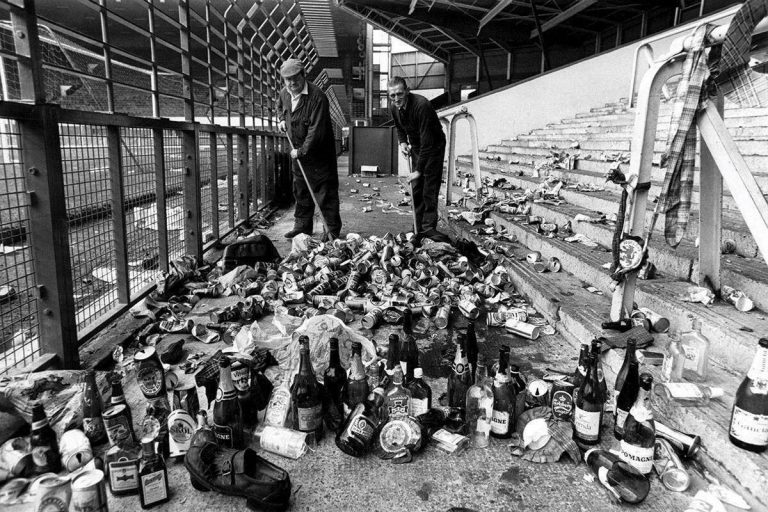
We thank Brendan and Peter for their recollections. It’s clear that Celtic’s support was overwhelming for the local constabulary and the club. It’s also clear that the Burnley home end, was “taken” during this encounter, one of the only times this ever happened apparently, such was the extent of Celtic’s violence. Those present will never forget the scenes, that much is obvious.
Thanks for visiting, and don’t forget to share this article, as this really helps our channel grow, to give you bigger, better, content. Like our previous article, West Brom vs Stoke 1977: When 50 Stoke Lads Invaded the Brummie Road Until the next article, bye for now.
📺 Watch the Original Video
If you enjoyed this article, watch the full story from The Terrace Archive below.