
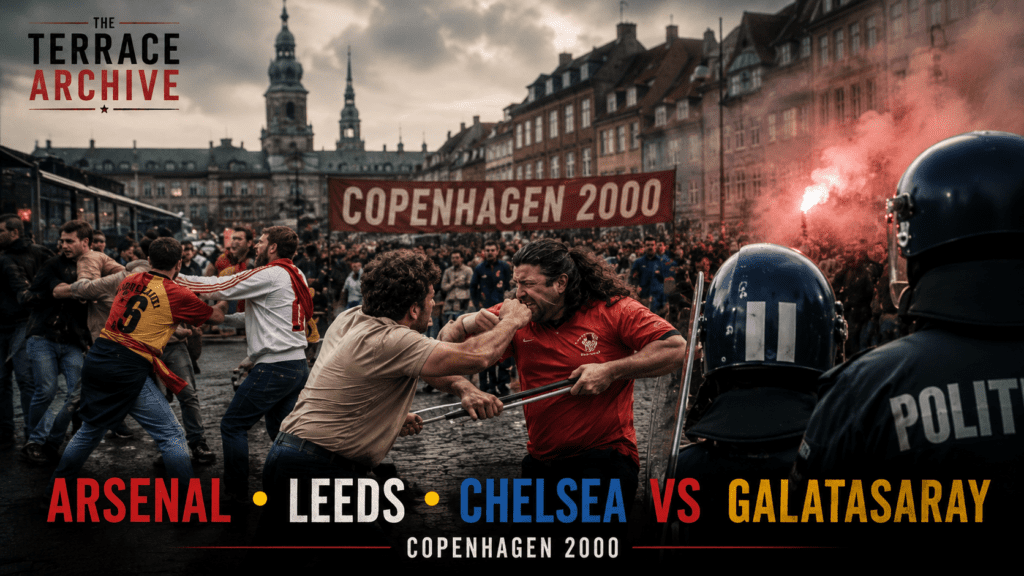
This infamous event has gone down in hooligan folklore history, because it’s one of the only times, English firms have united in their hatred of a foreign firm, and even worked together in a common goal of defeating an enemy. Did it work? You decide. Let’s hear the stories.
First we have Arsenal Gooner fan George, who told us….”When people talk about Copenhagen they usually start with the final, but for most of the lads I knew, the football almost felt secondary by the time we got there. We flew out the day before and the city was already packed. Arsenal colours were everywhere, but so were faces that had nothing to do with Arsenal. You’d walk into a bar and see Leeds lads at one table, Chelsea faces at another, Cardiff boys somewhere near the door. Normally half of those people wouldn’t be in the same room without trouble following, but this was different. The events in Istanbul a few weeks earlier had changed the mood completely. Every conversation drifted back there. Nobody needed to explain why so many British lads had travelled. The city itself was brilliant, clean streets, canals and friendly locals, but there was a tension underneath everything. Turkish flags hung from balconies, drums echoed across the squares and every group seemed to be watching every other group.”
“That evening we headed away from the busy centre and ended up near the dock area. It was quieter there and easier to keep an eye on things. The pubs were filling steadily and stories were flying around from every direction. Someone claimed there had already been trouble near the station. Somebody else reckoned a group of British lads had been chased through the city. Nobody knew what was true and what wasn’t. That’s how these trips always were. Rumours travelled faster than facts. What I do remember was the sheer number of people there. It felt less like a football crowd and more like every rivalry and grudge in Europe had arrived in the same city at the same time. Danish police were visible everywhere and seemed nervous. Every hour more supporters landed at the airport. The atmosphere grew heavier as the day wore on. You could sense that Copenhagen wasn’t prepared for what had arrived on its doorstep.”
“Match day felt strange from the start. The city centre was packed and police seemed to be everywhere. Vans blocked roads, officers stood in groups and helicopters occasionally passed overhead. Plenty of ordinary Arsenal supporters wanted nothing to do with any of it. Families were sightseeing, fans were drinking and enjoying the occasion, but there was another side to the trip that was impossible to ignore. Every major square seemed to contain groups eyeing each other from a distance. The authorities clearly feared the worst. We spent most of the day moving between bars and avoiding the busiest areas. The football itself almost came as a relief. Once we reached the stadium the focus finally shifted back to Arsenal. Thousands of us sang ourselves hoarse. We genuinely believed we would bring the trophy home. Looking back now, we probably deserved better than the performance we produced.”
“The penalty shootout felt like a slow-motion disaster. Every Arsenal supporter in the ground seemed to know what was coming before the final kick was even taken. When Galatasaray won, the celebrations from their end were deafening while our side just stood there staring at the pitch. Afterwards we avoided the city centre and found a quieter bar near the hotel. Nobody felt much like celebrating anything. Years later, when people ask me about Copenhagen, they usually want stories about the disorder and the headlines. What I remember most is the atmosphere. Rival firms standing shoulder to shoulder. Thousands of supporters carrying old grudges into a foreign city. Police struggling to keep control of a situation that seemed bigger than football. It felt like one of those rare moments when football culture, rivalry and history all collided in the same place. The match lasted 120 minutes. The feeling around that trip lasted a lot longer.”
Leeds Ex Service Crew member, Carl told us…”I wasn’t interested in Arsenal and I certainly wasn’t interested in a UEFA Cup Final involving Arsenal. If you’d told me a year earlier I’d be flying across Europe to watch Arsenal play, I’d have laughed in your face. But Copenhagen wasn’t really about Arsenal. Not for most of the Leeds lads I knew. The events in Istanbul had changed everything. The deaths of Christopher Loftus and Kevin Speight hung over every conversation, every away trip and every pub discussion that spring. The papers had covered it nonstop, but among football lads the story felt much closer to home. When word got around that Galatasaray would be meeting Arsenal in the final, plenty of Leeds lads made plans almost immediately. We weren’t travelling as supporters of Arsenal. We weren’t travelling because we suddenly liked Arsenal. We were travelling because there was a feeling that football rivalries had been put on hold for a few days. Copenhagen was where everyone ended up. The city became a magnet for lads from all over Britain who felt the same way.”
“The first thing that struck me when we arrived was how many familiar faces were already there. Some I’d seen at grounds across the country for years. Others I’d only known by reputation. Chelsea lads, Cardiff boys, Rangers faces, Swansea lads and plenty from Arsenal themselves. Normally half those groups wouldn’t share the same pavement without aggro. In Copenhagen they were drinking in the same bars and talking about the same thing. It was probably the only time in my life I’ve seen so many traditional rivals standing around together. The city centre was busy and noisy. Turkish supporters were everywhere, draped in flags, beating drums and singing long into the night. To be fair, they travelled in huge numbers and created an incredible atmosphere. But there was no escaping the tension. You could feel it every time groups crossed paths. Police seemed to be on every street corner and still looked overwhelmed. Rumours spread constantly. Every pub had somebody claiming they’d heard about trouble somewhere else. Most of it was probably nonsense, but it kept everyone on edge.”
“Match day was even more intense. The city felt completely different from the relaxed place we’d arrived in twenty-four hours earlier. Roads were blocked, officers were everywhere and helicopters circled overhead. We spent most of the day moving between pubs and side streets, avoiding the busiest areas while keeping an eye on what was happening. What always annoyed me afterwards was the way newspapers reported it all. They made it sound like every Arsenal fan in Copenhagen was there for trouble, which simply wasn’t true. Most Arsenal supporters were there for the biggest European match in their club’s history. Families, ordinary fans and people who’d spent fortunes following their club across Europe. But there was another crowd in the city as well, made up of people from various clubs whose reasons for travelling were completely different. The Danes probably couldn’t understand it. To them it must have looked like half of British football had turned up at once. Even by the standards of that era, it felt unusual.”
“When Galatasaray won the trophy on penalties, the city seemed to split in two. One half erupted into celebration while the other disappeared into pubs to drown disappointment. We were already planning the journey home by then. Looking back after all these years, what stays with me isn’t anger or revenge. It’s the sheer strangeness of the whole thing. Leeds lads travelling to an Arsenal match. Chelsea and Cardiff faces sharing drinks with people they’d normally be facing across a city centre. Thousands of supporters from different countries packed into a beautiful Scandinavian city carrying baggage from events that had happened hundreds of miles away. The newspapers focused on arrests, disorder and confrontations. Fair enough, that makes headlines. But what I remember is the atmosphere. A feeling that something unusual was happening. A feeling that football’s normal rules had been suspended for a few days. Once everyone got home, rivalries started again. But for that brief period in Copenhagen, football’s old enemies found themselves standing on the same side of the street.”
And finally, Galatasaray Ultra, Muhmet told us…”When we landed in Copenhagen, it felt like the entire city had turned red and yellow overnight. Supporters had travelled from every corner of Turkey and from Turkish communities all across Europe. Airports, ferries and trains seemed to be carrying endless streams of Galatasaray fans. For us, this wasn’t just another European away trip. Galatasaray were ninety minutes away from making history. We had already knocked out some of Europe’s biggest clubs to reach the final and there was a feeling back home that something special was happening. But alongside the excitement there was another reality nobody could ignore. Ever since the events in Istanbul after the Leeds match, the spotlight had been fixed firmly on Galatasaray supporters. Everywhere we went there were cameras, journalists and police. Every newspaper seemed to be predicting trouble. By the time we reached Denmark, it felt as though half of Europe expected the city to explode before a ball had even been kicked.”
“The first night in Copenhagen was unlike anything I’d experienced before. Thousands of supporters packed the bars, squares and streets. Arsenal fans were everywhere, but so were supporters from clubs that had nothing to do with the final itself. We quickly realised this wasn’t simply Arsenal versus Galatasaray. There were Leeds supporters, Chelsea faces, Rangers supporters and others who had travelled despite having no connection to either club. Stories spread through the city every hour. Somebody claimed there had been a confrontation near the docks. Somebody else said arrests had already been made. Nobody really knew what was true. The police presence seemed to grow constantly. Every major street had officers watching from a distance. Despite the tension, there were still ordinary supporters enjoying the occasion. Families took photographs by the harbour, fans drank in cafés and tourists wandered through the city looking confused by the sea of football colours and constant noise.”
“Match day arrived with Copenhagen feeling more like a city under a security operation than a host for a football final. Roads were closed, barriers appeared everywhere and police helicopters circled overhead. Supporters moved through the streets in huge numbers while officers carefully monitored every gathering. The atmosphere was intense but also exciting. We spent hours singing, waving flags and talking about what victory would mean back home. Many of us had followed Galatasaray for years and never imagined seeing the club reach a European final. Inside the stadium the scale of the occasion finally hit home. The noise was incredible. Both sets of supporters knew they were witnessing something historic. The match itself was tense rather than spectacular. Every missed chance felt enormous and every decision by the referee produced a reaction from thousands. As extra time ticked away, nerves spread through the stands. Deep down, many of us sensed penalties were becoming inevitable.”
“The penalty shootout was torture. Every supporter seemed frozen in place as the kicks were taken. When the winning penalty finally hit the net, everything exploded at once. Strangers embraced each other, grown men cried and flags appeared from every direction. Songs echoed around the stadium long after the final whistle. For us, it wasn’t simply a victory. It was the greatest moment in the club’s history. Back home in Turkey, celebrations continued throughout the night and into the following day. Looking back now, people often remember Copenhagen for the headlines, the police operations and the disorder surrounding the match. Those events became part of the story whether anyone liked it or not. But from where I stood, the lasting memory was something else entirely. I remember thousands of Galatasaray supporters travelling across Europe believing they were about to witness history. And I remember the moment that history finally arrived, when Galatasaray reached the summit of European football.”
We thank George, Carl and Muhmet for their recollections. It’s clear that the two English clubs did unite to try and seek revenge on the Galatasaray Ultras. It’s less clear whether they achieved their aim. What do you think? Was it a successful joining of the firms? Let us know in the comments if you were there and what happened to you.
Thanks for watching. Please share this article, until the next article, bye for now.